

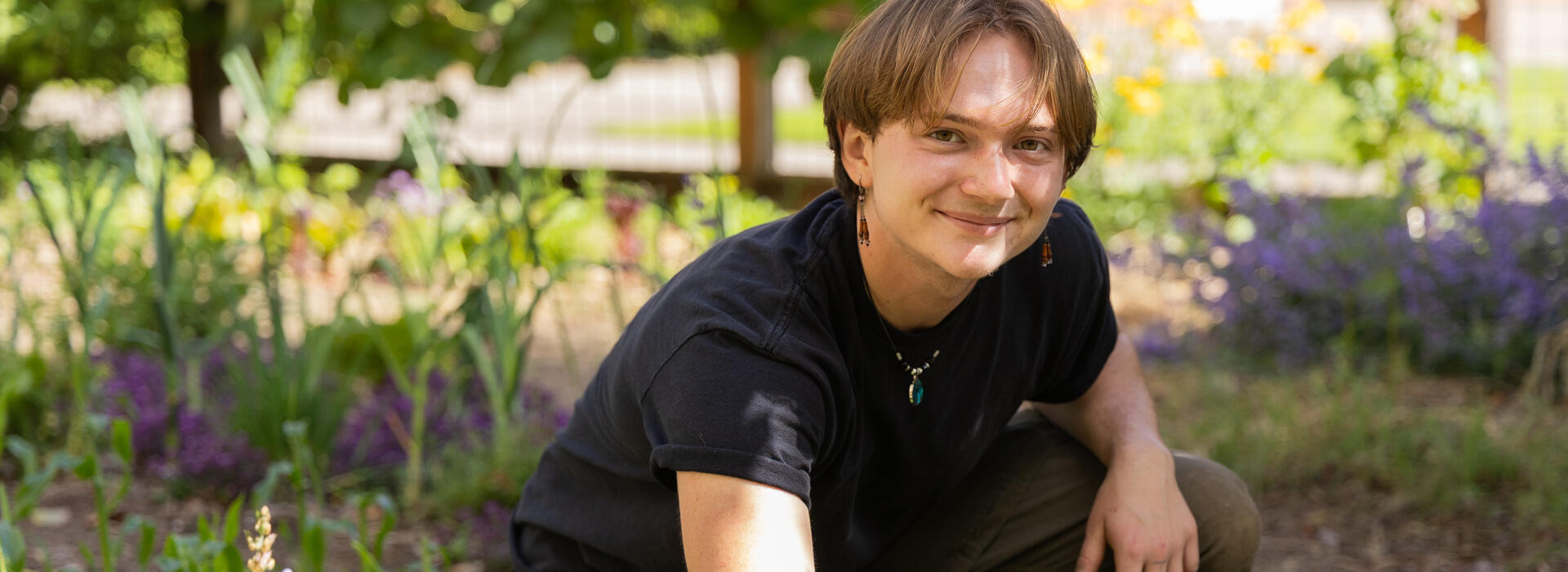
Summer 2025 — Driven by a passion for sustainable agriculture and social justice, botany and horticulture student Milo Tisdale is supporting the local community while caring for the Food Forest at Oregon State University.
The Food Forest, started in 2015, sits beside Callahan Hall on the Corvallis campus and is filled with fruits, vegetables and herbs. This student-led project slowed after the COVID-19 pandemic, but it experienced a regeneration with Tisdale’s involvement. Now visitors can find an array of plants and trees, including squash, zucchini, grapes, corn, tomatoes, strawberries, sweet potatoes, melons and figs.
“I really focus on diversity — like today I just planted some carrots and parsnip seeds. I did radishes last week and will be going in with some beets tomorrow, some rutabagas and turnips,” says Tisdale, who is entering his third year at OSU. “Because when you're growing a bunch of the same things, you can have issues with pests and disease. When you have a large diversity, you tend to have less issues.”
The Food Forest, a partnership of University Housing & Dining Services, Crop and Soil Science, and Horticulture, is in part an educational tool. In addition to providing herbs and greens to the UHDS restaurant Five Four One, the garden is open to community members who can pick fruit and vegetables for their personal use.
Visitors to the roughly 2,600 square feet garden are exposed to what different plants look like and how food grows. For example, most people are not aware of how long it takes a tomato to grow, Tisdale says. He sees value in students and other guests being “able to walk past (produce) every day and see the change in landscape and see how it changes through the season.”
Harvest supports the Basic Needs Center
Tisdale began on the UHDS landscaping team before transitioning his focus to the Food Forest as a summer 2024 intern. In addition to the perennials, including apple, pear, persimmon and mulberry trees, there is a section dedicated to annuals. He designed and planted the current garden layout. “I like to call myself the curator and caretaker,” he says.
When Tisdale took over the Food Forest last summer, he ended up with an abundance of produce at a time when there were not many students on campus. Connecting with the Basic Needs Center seemed like a natural fit, so students and community members who visit the center would have access to fresh and local food.
Last year, Tisdale estimates that the Food Forest gave about 500 pounds of food to the BNC between April and September. He hopes to increase donations to 1,000 pounds in the coming year. Tisdale estimates that the donations have averaged about 5 to 12 pounds per week since late February and they are increasing as the weather gets warmer.
He plans to implement more succession planning — so as the summer season ends the garden will transition to more fall and winter crops and allow him to keep donation levels up — and is taking other measures to improve outcomes. “I planted a little too densely last season, so I've spaced a bit more out and have better trellising and got some better supplies,” he said. “I'm going to be pruning back more to produce bigger, better fruits. So, I'm anticipating that I'll probably be able to get more than 1,000 pounds this year.”
Committed to alternative farming methods
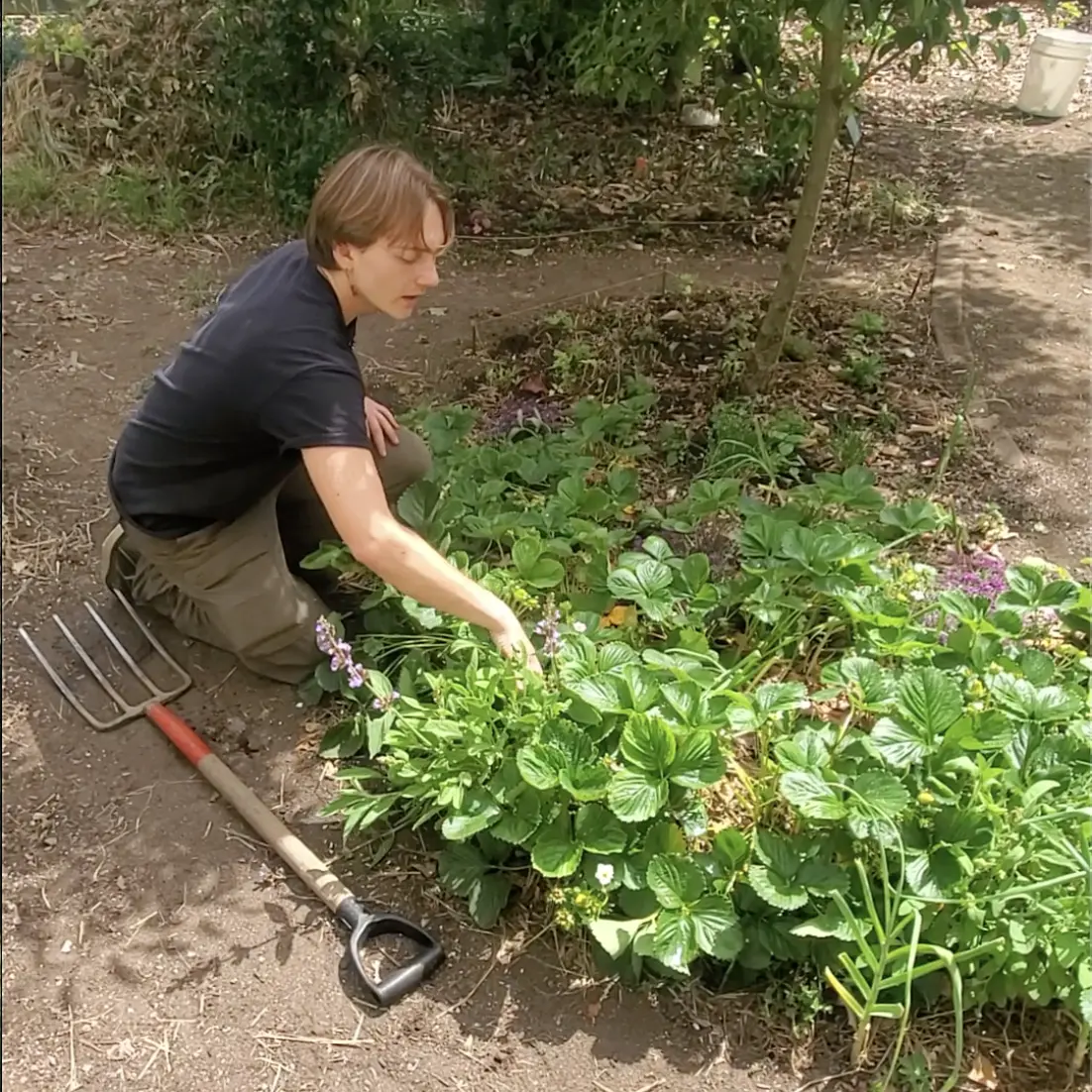
Tisdale’s focus on community well-being is evident in his approach to farming.
He recently declared a customized concentration for his botany degree in resilient agriculture that focuses on building biodiverse, sustainable food systems. This is in contrast with monocultured agriculture, which focuses on growing a single crop in a specific area, often over an extended time. Monoculture practices accelerated after World War II; they can harm soil and contribute to other environmental consequences.
“I started developing an interest in permaculture agricultural systems … as alternatives to monocultured agricultural systems and finding ways to grow a lot of food in a small amount of space and support the community and local ecology,” Tisdale says.
One example of how Tisdale is accomplishing these goals is through the implementation of a “Three Sisters” planting strategy, where you plant squash between the corn and then beans outside of the corn.
“That's a form of companion planting, a symbiotic planting method that was developed by Indigenous people in the Americas,” he says. “That's kind of a common theme to the Food Forest — I'm very big on companion planting and planting stuff densely, but in ways that provides a benefit. Like planting herbs near a certain crop that deter pests or flowers that attract different insect populations and pollinators.”
The wide use of pesticides in global farming practices is harming pollinators and other beneficial insects, but the Food Forest is a habitat for these at-risk organisms. For example, native bee species frequently visit the garden attracted to sweet alyssum, marigolds, sage, and other plants.
Tisdale also focuses on layering crops and planting crops that provide ground cover to enhance the soil.
“The more and more I learn about the way that we produce food and the different alternatives to the way that we produce food makes me really determined to help make a change in our food system for the better,” says Tisdale. “The way that we grow a lot of things has a lot of negative effects on the people who live near those farms, the people who work on those farms, and the people who eats those foods.”
Tisdale believes sustainable agriculture — specifically biodiverse agriculture methods that take a natural approach to pests — helps address social issues. He says that good-quality, nutritious and accessible food is the main goal of this approach, but there are also other benefits, like pesticide-free farms for workers, environments that create connections to nature and enhance mindfulness, and economic advantages.
“It’s kind of just an overarching pathway of benefits both socially and physically,” Tisdale says. “This is really where I think that I can create the most benefit in the world.”
Written by Carolyn Boyd. Cover photography by Becca Harmonson; additional photography by Carolyn Boyd.